Difficult to Clean in Air Fryer: What 97,574 Reviews Reveal
Difficulty Cleaning: The “Hidden Killer” of the Air Fryer Industry
Many people purchase air fryers with the initial expectation of “oil-free, healthy, and fast cooking”. They imagine making french fries and grilled chicken wings in 15 minutes, wiping the appliance for two minutes after eating and storing it in the cabinet, but reality often falls short: after two to three months of use, grease trapped in gaps can’t be scraped out, burnt residue on the fry basket takes over ten minutes to scrub, and eventually the air fryer is left in a corner collecting dust, consistently ranking high on the annual list of the most impractical small home appliances. Our analysis of 97,574 real user reviews covering 4,937 products found that 21% of negative reviews are related to cleaning difficulties — this ratio is second only to “product failure to operate”, and is a “hidden consumption trap” that most users never anticipate before purchase.
A very typical user journey is: for the first two weeks after buying an air fryer, users are full of novelty, make a variety of different dishes every day, never carefully read the cleaning instructions, and only casually rinse the fry basket before putting it away after use; after 8 to 10 uses, they find the fry basket sticks to food more and more easily, black mold grows in the gaps along the edge of the drawer, and a burnt smell wafts from near the heating tube. When they try to clean the appliance thoroughly at this point, they find many parts cannot be disassembled or reached for wiping, so they either continue to use it despite the odd smell, or simply throw it away and replace it with a new one.
Why Is Cleaning Difficult? An In-depth Breakdown of Root Causes
Air fryer cleaning difficulties are never caused by a single factor, but are the combined result of material selection, manufacturing processes, and usage habits. We can break down the issue from three dimensions:
Material Science Dimension: Coating Failure Is the Core Cause of Sticking
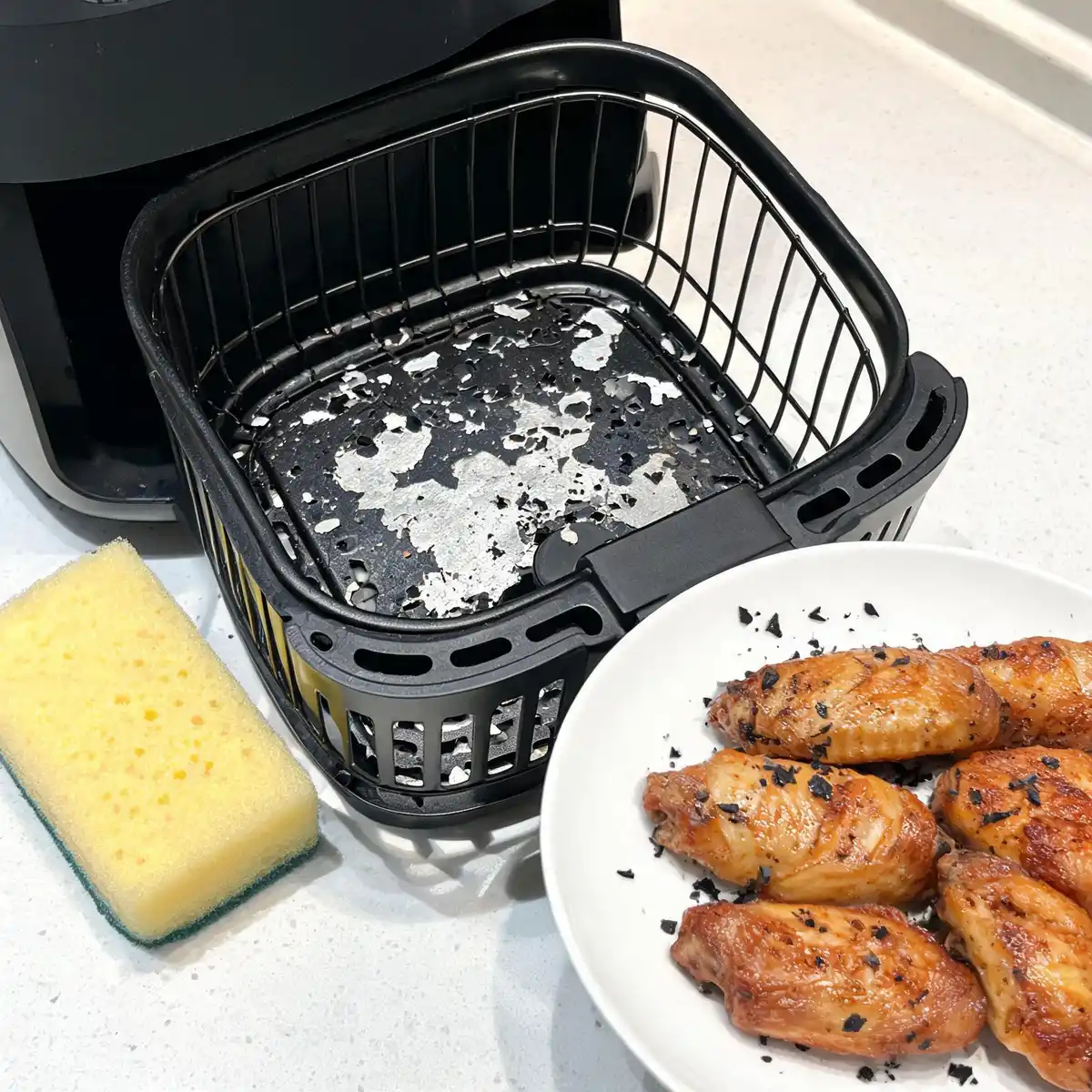
At present, the fry baskets and oil drip trays of most air fryers use non-stick coatings, and the adhesion, thickness, and high temperature resistance of the coating directly determine cleaning difficulty. If manufacturers use low-quality non-stick coatings to cut costs, the coating is often only 8-12μm thick with insufficient adhesion, and local peeling will occur after 8-10 normal uses, just like an enamel bowl with chipped paint. The exposed metal base in the peeled area comes into direct contact with food, and starch and protein will firmly adhere to the metal surface after high-temperature coking, requiring repeated hard scrubbing with a brush to remove. As one user mentioned in a negative review: “Not nonstick… Cleaning this is a pain… the basket isn’t nonstick and I have to scrub a lot after every use… and the black “nonstick” basket color is already coming off after about 8-10 uses”, once this situation occurs, the cleaning burden increases exponentially.
Manufacturing Process Dimension: Design Defects Are the Core Cause of Dirt Accumulation
Many cleaning problems are predetermined at the product design stage, and common design defects fall into four categories: The first type is non-removable internal body design: the heating tube and circulation air duct are sealed inside the body. Oil fumes generated during air fryer operation flow into these areas with the hot air circulation, and once grease adheres to these surfaces, it cannot be wiped away at all. Over time it carbonizes and turns black, emitting a burnt smell every time the appliance is heated; The second type is unreasonable air duct gap design: there is a gap of more than 2mm at the junction of the air duct, fry basket and drawer, where food residue and grease can easily get stuck. Ordinary rags and brushes cannot reach into these gaps, so users can only pick out debris little by little with a toothpick; The third type is oil drip tray design defects: either there is no independent oil drip tray, so grease flows directly to the bottom of the drawer, or the oil drip tray is less than 1cm deep. When cooking high-oil foods such as grilled chicken wings and pork belly, oil can easily overflow and flow into the gaps of the body; The fourth type is accessories not suitable for dishwasher cleaning: many users are used to putting small home appliance accessories in the dishwasher to save time, but if manufacturers use materials that are not resistant to high temperatures or detergents, the product will be marked “hand wash only”, forcing users to scrub manually, which greatly increases the cleaning burden. Another process defect is excessive accessory tolerance, as one user mentioned: “the basket doesn’t fit into the fryer well, so you have to jiggle it around or force it to get it to go in”. An excessively large fit gap between the fry basket and drawer not only causes jamming during use, but also makes grease in the gap very difficult to clean.
Usage Habit Dimension: Improper Operation Magnifies Cleaning Difficulty
Many users’ usage habits also exacerbate cleaning problems: for example, waiting until the fryer is completely cool before cleaning, so grease solidifies or even carbonizes during the cooling process, with an adhesion strength over 3 times higher than when it is warm; some users are used to cleaning the fry basket with steel wool or hard bristle brushes, which directly scratch the non-stick coating and accelerate coating peeling; in addition, taking no protective measures when cooking food heavy in oil and sauce, so sauce drips directly onto the oil drip tray or even into the air duct, will also greatly increase subsequent cleaning workload.
Performance Comparison of Cleaning Difficulty for Different Materials
The material of air fryer parts that come into contact with food directly determines cleaning difficulty. We have sorted out the performance differences of the three mainstream materials on the market for your reference:
| Material Type | Cleaning Friendliness | Advantages | Limitations |
|---|---|---|---|
| Ordinary Teflon non-stick coating | ★★★ | Good non-stick effect for new units, low cost, affordable price | Low high temperature resistance upper limit (≤260℃), low hardness, easy to scratch and peel, short service life |
| Food-grade ceramic non-stick coating | ★★★★★ | High high temperature resistance upper limit (≤400℃), high hardness, scratch-resistant, no peculiar smell | Non-stick effect is slightly inferior to brand new Teflon coating, high production cost, higher selling price |
| Food-grade 304 stainless steel | ★★ | Durable, no risk of coating peeling, suitable for long-term high-temperature use | No inherent non-stick property, food sticks easily, requires long soaking and scrubbing time |
| Many products described as “easy to use, hassle-free to clean” in user positive reviews generally use food-grade ceramic non-stick coating paired with a fully detachable design. Under normal use, they only need a wipe with a soft cloth to be clean, requiring almost no extra scrubbing. It should be noted that no material is “permanently non-stick”: even the best ceramic coating will gradually lose its non-stick effect if it is scrubbed with hard brushes or dry burned for a long time. |
How to Avoid Cleaning Difficulties? Purchase and Usage Guide
Many cleaning problems can be avoided at the purchase stage. Combined with correct usage habits, you can fully control the air fryer cleaning time to within 2 minutes per use.
Core Details to Focus on When Purchasing
- Prioritize detachable design: Give priority to models where all food-contact parts (fry basket, oil drip tray, air duct baffle, drawer inner tank) can be disassembled separately, to avoid uncleanable hygiene dead corners;
- Pay attention to coating type and parameters: If cleaning convenience is your top priority, choose ceramic non-stick coating first, followed by high-grade Teflon coating marked with “abrasion resistance ≥ 10,000 cycles”. Do not choose low-priced products without any marked coating parameters;
- Check oil drip tray design: The oil drip tray should be at least 1cm deep, preferably with an oil leak hole design, to avoid grease overflow;
- Confirm dishwasher compatibility: If you have a dishwasher at home, be sure to check if the product description notes “accessories are dishwasher safe”, which can greatly reduce manual cleaning burden. If you have a sufficient budget, the following process details are worth paying extra for: accessories made with seamless welding technology (no gaps to trap grease), easy-to-clean coating on the internal body, and detachable air duct for cleaning. These designs can further reduce cleaning difficulty.
Correct Usage and Maintenance Methods
- Choosing the right cleaning time cuts effort in half: After using the air fryer, clean it immediately when the temperature drops to around 40°C (warm to the touch, not burning). At this time, grease is still liquid and can be wiped off with a damp cloth. Do not wait until it is completely cool and grease has solidified to clean;
- Choose cleaning tools correctly: Never use steel wool or hard bristle brushes to clean non-stick coatings. Sponges, silicone brushes or soft cloths are sufficient. If there is burnt residue stuck to the surface, soak it in 40°C warm water with dish soap for 10 minutes before wiping, and it will come off easily;
- Pre-protection reduces cleaning burden: When cooking food heavy in oil, sauce, or containing cheese, you can line the fry basket with parchment paper or tin foil, taking care not to block the air inlet and outlet. This prevents most grease from sticking directly to the fry basket;
- Regular deep cleaning: Clean grease from the fry basket and oil drip tray after each use. Clean the internal body and air duct at least once a week: you can use a long-handled soft brush to scrub off accumulated oil, then wipe it clean with kitchen wipes.
Common Misconception Correction
- Misconception 1: “Internal grease doesn’t need to be wiped if you can’t see it”: Accumulated oil in the air duct that is not cleaned for a long time may spontaneously ignite at high temperatures, posing a fire hazard, and will produce a burnt smell that contaminates food, so it must be cleaned regularly;
- Misconception 2: “Baking soda plus white vinegar is a universal cleaner”: Acidic white vinegar will corrode non-stick coatings and accelerate coating aging and peeling. Only ordinary dish soap is needed to clean non-stick coatings;
- Misconception 3: “You don’t need to clean thoroughly every time, just rinse the fry basket”: If leftover oil in the oil drip tray is not poured out after each use, it will splash everywhere when heated next time, or even flow into body gaps, making it much harder to clean later.
We also provide unified answers to the most commonly asked questions: Grease in internal dead corners of the air fryer can be cleaned with a long-handled soft brush and neutral degreaser: spray the solution, leave it for 5 minutes before scrubbing, then wipe repeatedly with a damp cloth; food sticking to the fry basket is either caused by peeling coating, excessively high cooking temperature leading to food coking, or failure to brush a small amount of oil in advance; as long as you choose a model with fully detachable design, high-grade non-stick coating, and dishwasher support, you will barely need to scrub hard; you should clean at least the fry basket and oil drip tray after each use, and thoroughly clean the internal body at least once a week.
“Pitfall Avoidance” Lessons from Real Users
We have selected several of the most representative user negative experiences from tens of thousands of reviews, for you to reference to avoid similar problems:
User Lesson 1
“Not nonstick… Cleaning this is a pain… the basket isn’t nonstick and I have to scrub a lot after every use… and the black “nonstick” basket color is already coming off after about 8-10 uses…” Lesson Summary: Don’t just look at the “non-stick” label on promotional materials, pay attention to the specific type and wear resistance parameters of the coating. Do not use hard cleaning tools to scratch the coating during use. If you find large areas of coating peeling, it is recommended to stop using the unit: this will not only greatly increase cleaning burden, but also poses food safety risks.
User Lesson 2
“not easy to clean and very limited things i can cook … well i try on this item, not easy to clean and very limited things i can cook with this item” Lesson Summary: If you often cook high-oil, high-sauce foods such as grilled pork belly, grilled chicken wings, and baked rice, be sure to choose a model with a deepened oil drip tray and fully detachable design, to avoid grease overflowing into body gaps that cannot be cleaned, leading to fewer and fewer types of food you can cook over time.
User Lesson 3
“It cooks great—but poorly fitted basket was a dealbreaker We love how well it cooks, but as others have said, there is a unit quality problem. The basket doesn’t fit into the fryer well, so you have to jiggle it around or force it to get it to go in.” Lesson Summary: Excessive accessory tolerance will not only cause jamming during use, but also makes grease and food residue remaining in gaps very difficult to clean. When purchasing, pay attention to the fit of the fry basket and drawer: no obvious shaking when wiggled and smooth pulling/pushing indicates qualified workmanship.
User Lesson 4
“This is not a good appliance I had a smaller air fryer that worked great. This one not so much! It has been hard and cleaned numerous times still has a burning plastic smell. It does not cook the food all the thru! But it’s pretty good at burning it before it’s finished.” Lesson Summary: If there is still a burnt smell after multiple cleanings, it is most likely caused by carbonized accumulated oil in the internal air duct, or the body being made of low-quality heat-resistant materials. This type of accumulated oil is very difficult to remove with regular cleaning. When purchasing, confirm that the internal body material is food-grade heat-resistant, and that the air duct supports disassembly for cleaning.
Related Deep Analysis in This Category
- Non-Stick Coating Peeling — 36% of complaints relate to this
- Poor Cooking Performance — 27% of complaints relate to this
- Short Lifespan & Easy Malfunction — 42% of complaints relate to this
- Structure & Design Defects — 19% of complaints relate to this
🛠️ Practical How-To Guides
Based on the analysis above, we've prepared actionable daily solutions for you:
Air Fryer Internal Dead Corner Oil Stain Cleaning: 3-Step No-Disassembly Method, Spotless in 5 Minutes
For air fryers with non-detachable bodies, teach you to clean old oil stains in hidden corners without disassembly, suitable for total beginners
Read Full Guide →Fix Air Fryer Oil Tray Overflow: 3 Modification & Cleaning Tricks, Barely Need Scrubbing After Use
Solve the oil overflow problem caused by missing oil tray or too shallow oil tray, teach you low-cost modification methods to greatly reduce subsequent cleaning burden
Read Full Guide →How to Clean Grease in Air Fryer Air Duct Gaps: 2 Low-Cost Tricks Without Damaging the Machine
Solve the problem that grease hidden in air duct gaps is hard to wipe, use common household materials to remove deep grease, avoid odor and reduce heating efficiency loss caused by long-term accumulation
Read Full Guide →Stop Air Fryer Basket Food Sticking & Coating Peeling: 4 Useful Tips to Avoid Scrubbing Pain
Explain the core reasons why food always sticks to the fryer basket, teach you practical methods to protect the coating and reduce sticking in daily use
Read Full Guide →Cookware Dead Corner Cleaning Guide: Choose Methods by Material to Remove Stains From Rivets, Seams & Rim Easily
Compare the cleaning differences of 4 common types of cookware: coated, stainless steel, cast iron, ceramic, and teach you to remove stains from hard-to-wash dead corners such as rivets, seams and pot rims
Read Full Guide →How to Clean Burnt Stainless Steel Cookware: 4 Steps to Restore Original Shine Without Abrasive Scrubbing
Break down practical tricks such as baking soda + vinegar burnt stain removal, hot water soaking, correct use of special cleaners, easily remove burnt stains and yellow gunk to keep the cookware shiny as new all year round
Read Full Guide →How to Clean Non-Stick Pans Without Scratching: 3 Tricks to Remove Hidden Black Gunk & Extend Coating Lifespan
Targeting the pain points of non-stick pans being prone to scratches and hidden dirt that gets worse with washing, teach you to remove stubborn black gunk without steel wool to avoid coating peeling and extend service life
Read Full Guide →