Hard to Clean & Material Safety Risks in Bakeware: What 464,291 Reviews Reveal
High Cleaning Difficulty & Unsafe Materials: The “Invisible Killer” in the Bakeware Industry
Many baking enthusiasts lose their passion not because of failed dough kneading or botched recipes, but because of unassuming tools: a baking tray just out of the oven after baking cookies feels slippery, still greasy even after three washes, and emits black smoke and strange odors when heated in the oven next time; after half a year of use, the residue scraped out of the snap gap of a springform cake pan has already carbonized, with no way to tell how much of it has mixed into finished cakes; a newly delivered pie weight has rust stains as soon as it is unpacked, and rusts badly again after being washed and baked once. We analyzed 464,291 real user reviews covering 44,060 products and found that 18% of negative reviews point to the two highly correlated issues of “high cleaning difficulty” and “unsafe materials”, which are the most easily overlooked hidden consumption traps in the bakeware field.
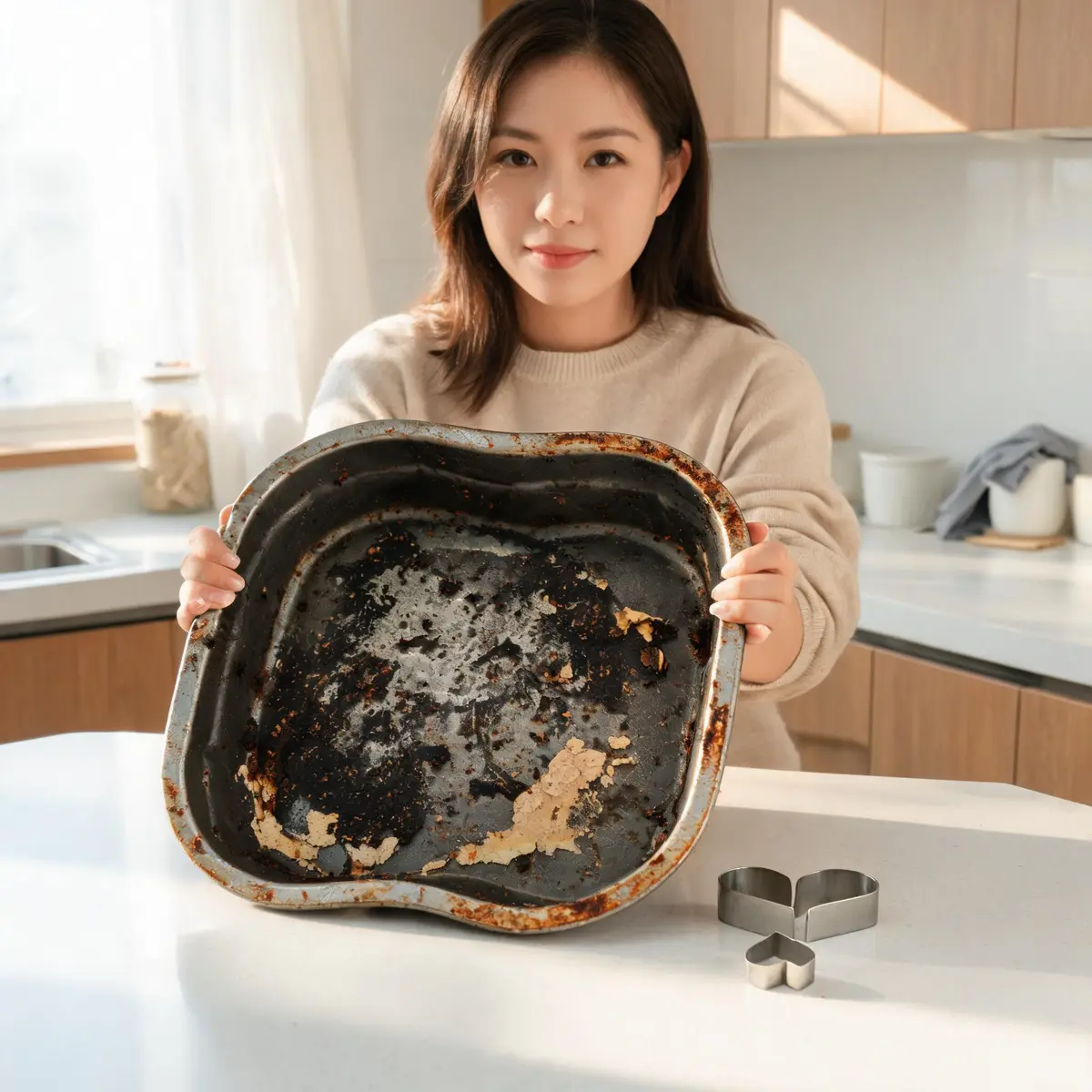
The most typical user scenario is: Novice baking enthusiasts buy an affordable baking set for convenience, the first two uses work perfectly fine, after 3 months of use, they gradually find that oil residue remains on the baking tray no matter how much they wipe it, strange gray patches appear when baking acidic fruit tarts, and later they even find a small piece of the coating on the baking tray has fallen off. They worry that ingesting the coating will affect their health, but feel it is a waste to throw it away since it was purchased not long ago, falling into a dilemma.
Why Are There High Cleaning Difficulty & Unsafe Material Issues? —— In-depth Breakdown of Root Causes
We can clearly sort out the root causes of these problems from three dimensions: materials science, manufacturing process, and usage habits:
Materials Science Level: Porosity and Chemical Stability Are Core Indicators
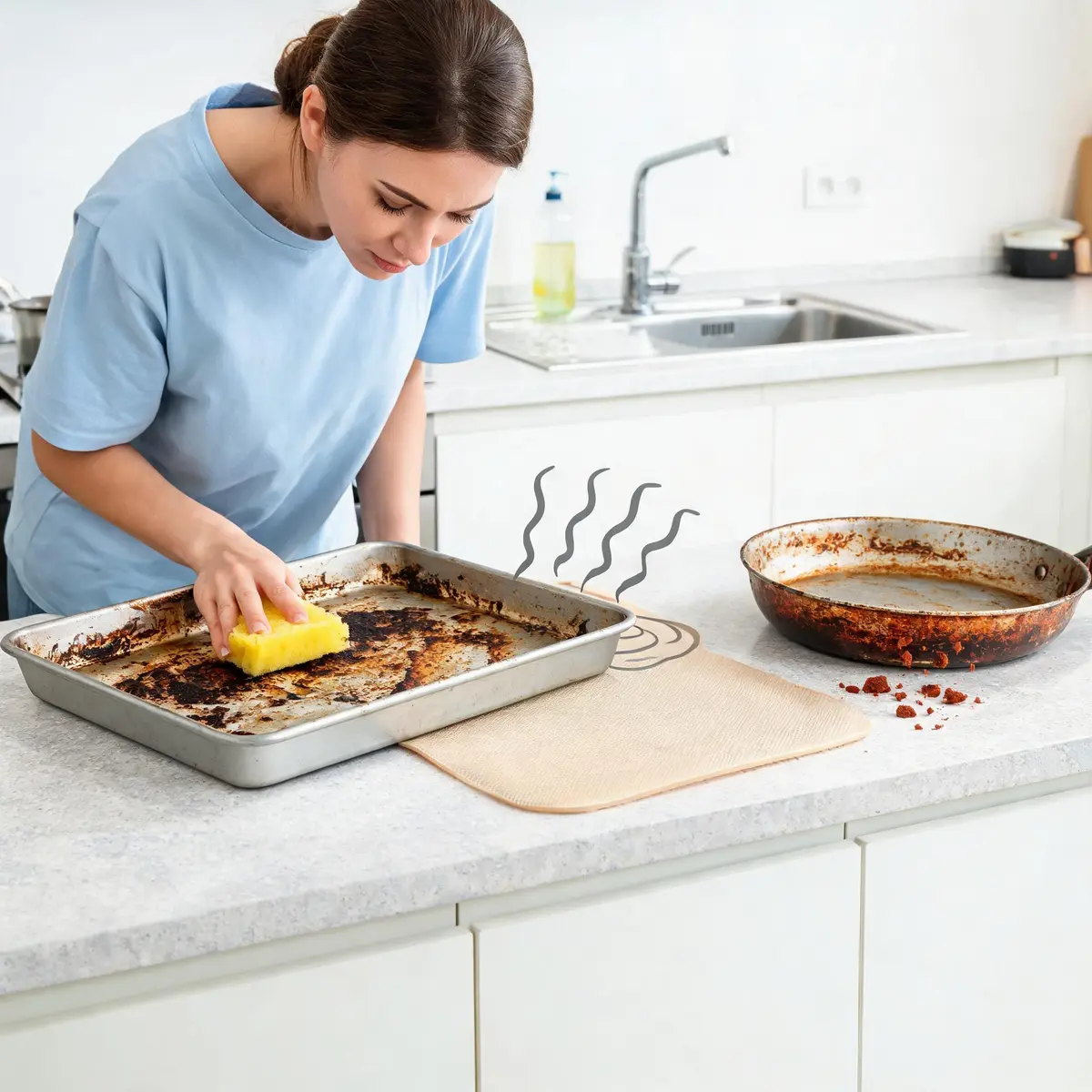
Many people wonder “Why can’t the oil on the baking tray be washed off no matter how hard I scrub?” The essential reason is that the porosity of the material is too high. Low-quality metal bakeware has not undergone dense surface passivation treatment, and there are a large number of tiny holes invisible to the naked eye on the surface, which absorb oil, food residues, and colored sauces into the interior of the material like a sponge. Even if you scrub repeatedly with detergent, you can only clean surface stains, and residues hidden in the pores will seep out when heated next time, contaminating food.
The widely concerned question “Is the odor released during heating toxic?” mostly comes from two problems: First, low-quality materials use recycled metals and industrial-grade raw materials, which themselves have excessive heavy metals (lead, cadmium, chromium) and harmful additives (plasticizers, free monomers), which will be gradually released at baking temperatures above 150°C; Second, low-quality non-stick coatings have insufficient crosslinking density, and molecular chains break and decompose at high temperatures, releasing volatile odors. As for “why is it easy to rust if water is not wiped dry after washing?”, the essence is that the rust-proof layer on the material surface is damaged or no rust-proof treatment has been done at all. After water enters the pores, it undergoes an oxidation reaction with the metal substrate, continuously producing rust stains.
The question “Will it be harmful if I eat fallen coating by mistake?” needs to be judged on a case-by-case basis: If it is an unqualified coating, it may contain unreacted harmful monomers, and long-term accidental ingestion poses health risks; If it is a standard food-grade coating, it is an inert polymer material itself, and a small amount of accidental ingestion will be excreted with metabolism. However, the exposed substrate after coating falls off is more likely to hide dirt and rust, so continued use is not recommended.
Manufacturing Process Level: Jerry-building Is the Hardest Hit Area
The first common process problem is unreasonable structural design: Many spliced baking trays, springform pans with non-detachable snaps, cooling racks with crimped gaps on the edges leave a large number of uncleanable dead corners at the splicing points. Batter, butter, and frosting get stuck in the gaps after being baked dry, carbonize and deteriorate over time, and release harmful substances every time they are heated.
The second problem is jerry-building in coating and surface treatment: Qualified food-grade non-stick coatings require at least 2-3 layers of application, plus high-temperature curing treatment. Many low-cost products only apply 1 thin layer of coating with insufficient curing time, which falls off after a few uses; The anodic oxide layer of many aluminum utensils is less than 3μm thick, far lower than the 10μm required for food-grade products, which is easily corroded by acidic food and precipitates aluminum ions.
The third problem is lack of food contact safety certification: Many small factories use industrial-grade materials to produce food-contact bakeware, without any safety testing, and illegally use unqualified raw materials. The cost is only 1/3 of that of qualified products, with extremely high safety hazards.
Usage Habit Level: Wrong Operation Accelerates Problem Occurrence
Improper use by many people also amplifies material and process defects: For example, rinsing a baking tray just taken out of a 200°C oven with cold water immediately, thermal expansion and contraction will cause the coating to crack and the surface passivation layer to fall off; Scrubbing utensil surfaces with steel wool or emery cloth will scratch a large number of tiny scratches, destroy the dense surface structure, increase porosity, and make subsequent cleaning more and more difficult; Using bakeware to store acidic, high-salt food for a long time will corrode the surface layer and accelerate material aging.
There is real user feedback that a newly bought cookie cutter was washed 3 times with dish soap, but the pressed cookie dough still had gray impurities, ruining the whole bowl of dough. The essence is that the porosity of the cutter material is too high, and metal debris and processing aids remaining during production are hidden in the pores, which cannot be completely removed even after repeated cleaning.
Performance Comparison of “High Cleaning Difficulty & Unsafe Materials” Across Different Materials
Common bakeware materials have their own advantages and disadvantages, and there is no absolutely perfect choice. We can clarify respective risk points according to the characteristic comparison of different materials:
| Material Type | Safety Risk Points | Cleaning Difficulty Performance | Positive Features of Qualified Products (Corresponding to Real Positive Reviews) |
|---|---|---|---|
| Food-grade passivated carbon steel (with qualified non-stick coating) | Low-quality coating is easy to fall off, low-quality carbon steel is easy to rust | Qualified coating has extremely low porosity, oil can be wiped off easily, cleaning difficulty is very low | User feedback: “The baking tray has even heat conduction, the baked cookies fall off with a light push, it is clean after wiping with a wet rag once, and there are no scratches after half a year of use” |
| Anodized aluminum | Low-quality anodic oxide layer is thin, easily corroded by acidic food and precipitates aluminum ions | Qualified oxide layer is dense, not easy to stick, ordinary stains can be cleaned by rinsing | User feedback: “There is no color seepage even after baking fruit tarts many times, and there is no residue after rinsing with hot water after use” |
| Food-grade silicone | Low-quality silicone contains industrial plasticizers, releases odor at high temperatures, and easily absorbs lampblack smell | Qualified silicone has good flexibility, food is easy to peel off, cleaning difficulty is low | User feedback: “High temperature resistance, no odor, the baked cake comes out directly when inverted, and there is no oil stain after rinsing” |
| 304/316 food-grade stainless steel | Low-quality industrial-grade stainless steel is easy to precipitate heavy metals, products without surface treatment are easy to stick to food | Uncoated stainless steel has high cleaning difficulty after sticking, stainless steel with good compactness is not easy to hide dirt | User feedback: “Although the baked meat jerky is a bit sticky, it can be brushed clean after soaking in hot water for 10 minutes, and there is no rust after one year of use” |
| High borosilicate glass | Fragile, easy to crack under sudden cold and heat | The surface is completely non-porous, no color seepage or dirt hiding, cleaning difficulty is very low | User feedback: “No residue after baking pudding, no smell at all after washing, it is reassuring to use” |
How to Avoid High Cleaning Difficulty & Unsafe Material Issues? —— Purchase and Use Guide
We only need to grasp the core bottom line standards and correct use methods to avoid the vast majority of problems:
Core Purchase Reference Indicators
- Food contact safety certification is the bottom line: No matter what material of bakeware you choose, you must confirm that the product has food contact safety certification that meets the standards of the corresponding region (such as China’s GB4806 series standards, US FDA food contact standards, EU LFGB standards, etc.). Do not buy products without any safety certification marks.
- Material parameters should be clear: Metal utensils should clearly indicate the type of base material (such as 304 food-grade stainless steel, food-grade high carbon steel), products with coatings should clearly indicate that the coating meets food contact safety requirements, and silicone products should clearly indicate that they are food-grade platinum silicone.
- Prioritize structural designs with fewer gaps: Try to choose one-piece formed baking trays and molds. For products with snaps and sealing rings, choose detachable designs to facilitate subsequent cleaning of residues in the gaps.
Process Details Worth Paying Attention To
Prioritize products with clear surface process labels: For example, metal products clearly indicate passivation treatment, anodic oxide layer thickness ≥10μm, and non-stick coatings clearly indicate multi-layer curing process. These details mean that the product has better surface compactness, lower porosity, lower subsequent cleaning difficulty, and higher safety factor.
Correct Use and Maintenance Methods
- Avoid thermal expansion and contraction: Utensils just taken out of the oven should be naturally cooled to below 40°C before contacting cold water. Do not directly rinse high-temperature baking trays with cold water to avoid coating cracking and surface layer falling off.
- Clean correctly: Do not use sharp and rough cleaning tools such as steel wool and emery cloth, soft sponges and nylon brushes are sufficient. For stubborn stains, you can soak them in hot water with baking soda for 15 minutes before wiping, and do not soak utensils in strong acid and strong alkaline cleaners for a long time.
- Avoid storing food for a long time: Take out the food in time after baking, do not use bakeware to store acidic, high-salt, high-sugar food for a long time to avoid corroding the surface layer.
Correction of Common Misconceptions
- Misconception 1: “Uncoated utensils are absolutely safe”: If it is low-quality stainless steel or carbon steel without food contact certification, the risk of heavy metal precipitation is much higher than that of qualified non-stick coatings. There is no absolutely safe material, only products that meet safety standards.
- Misconception 2: “The thicker the bakeware, the better”: Thickness is not the core indicator, surface compactness is. Some very thick low-quality products have higher porosity, which is more likely to seep oil and rust.
- Misconception 3: “New utensils can be used after being washed once”: It is recommended to boil newly purchased bakeware in hot water with white vinegar for 10 minutes (for high temperature resistant materials), or soak them in hot water with baking soda for 20 minutes to completely remove processing aids and debris remaining during production before use.
“Pit Avoidance” Lessons from Real Users
We selected 4 most representative user pitfall experiences from real negative reviews, you can refer to them directly to avoid pitfalls:
- User Experience: “The newly bought cookie cutter was washed 3 times with dish soap, but the cookie dough pressed out still had gray impurities, which ruined the whole bowl of dough, so I had to return it.” Lesson Summary: If there are still unknown precipitates and heterochromatic impurities on new utensils after multiple washes, it means that the material porosity is too high or unqualified processing aids are used. Do not continue to use it, return or exchange it in time to avoid accidental ingestion of harmful components.
- User Experience: “The pie weight I received had rust stains as soon as I unpacked it. I couldn’t find the contact information of the merchant, and finally I had to complain to the platform to get a refund.” Lesson Summary: If metal bakeware has rust stains as soon as it is received, it means that it has not undergone qualified rust-proof passivation treatment, or the material has been corroded due to poor storage environment. Such products will continue to rust during subsequent use and contaminate food, so do not use them reluctantly.
- User Experience: “The baking tray I bought feels very thin and soft, it deformed after two uses, it warps even when placed flat on the countertop, the filling leaks everywhere when baking, and the residue in the gap can’t be scraped out at all when washing.” Lesson Summary: Products that feel thin, have soft texture, many burrs on the edges, and rough craftsmanship when purchased usually have low material density and high porosity. They are not only easy to deform, but also have much higher subsequent cleaning difficulty than high-density, finely crafted products.
- User Experience: “The silicone baking mat I bought had a strong plastic smell as soon as it was put into the oven for heating, and the baked cookies had a weird smell, so they were completely inedible.” Lesson Summary: If silicone or plastic bakeware emits a pungent odor when heated normally for the first time, it means that industrial-grade raw materials are used or harmful additives exceed the standard. Stop using it immediately to avoid food contamination.
Related Deep Analysis in This Category
- False Advertising & Description Mismatch — 35% of complaints relate to this
- Poor Quality & Easy to Damage — 42% of complaints relate to this
- Poor Usability Performance — 28% of complaints relate to this
🛠️ Practical How-To Guides
Based on the analysis above, we've prepared actionable daily solutions for you:
Baking Pan Oil Stains Won't Come Off? 3 Home Hacks to Remove Stubborn Stains in 10 Minutes
Share actionable steps to clean stubborn oil stains on high-porosity bakeware with common household ingredients such as baking soda and vinegar, no need to buy professional cleaners.
Read Full Guide →Can You Use Bakeware with Peeling Coating? Is Ingestion Poisonous? A Complete Guide
Popularize safety standards for different coatings such as Teflon and ceramic, teach you to judge whether bakeware with peeling coating needs to be discarded, and the correct treatment after accidental ingestion.
Read Full Guide →Gaps in Bakeware Hide Dirt and Get Moldy Easily? 4 Daily Maintenance Tips to Extend Service Life
For bakeware with splicing gaps and complex structures, share maintenance steps after daily use and cleaning to reduce the probability of stain residue and coating peeling.
Read Full Guide →Worried About Toxic Fumes When Heating Bakeware? 4 Selection Rules to Avoid Inferior Harmful Products
Teach ordinary consumers to choose qualified and safe bakeware from the dimensions of material, coating, compliance label and structural design, avoiding the risk of heavy metal and harmful additive release.
Read Full Guide →