Size & Specification Not As Advertised in Dining Ware: What 242,872 Reviews Reveal
Inconsistency Between Size Specifications and Promotion: The “Hidden Killer” in the Tableware Industry
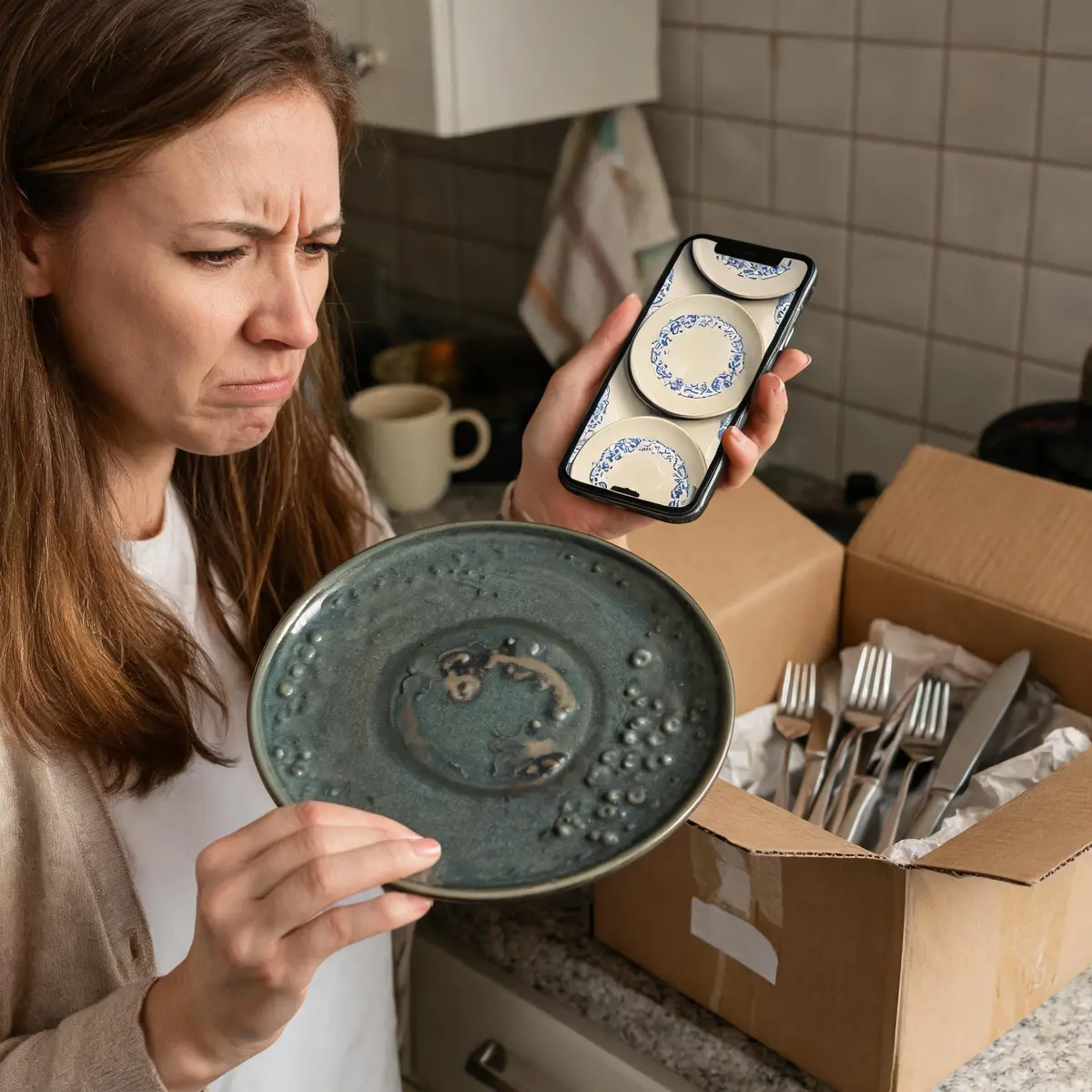
Have you ever had this experience: you are scrolling through a shopping platform and get attracted by tableware with outstanding appearance. The promotional image shows it can easily hold a whole steak with pasta, but when you receive it, you find it can’t even hold an ordinary home-cooked dish. You use it reluctantly for a few months, spilling food all over the table every time you eat, but it’s already past the after-sales period when you want to return or exchange it, so you can only pile it in the corner of the cabinet to collect dust. This is not an isolated case: after analyzing 242,872 real user reviews covering 37,254 products, we found that 35% of negative tableware reviews are related to inconsistency between size specifications and promotion. This problem has become the most frequent “hidden trap” in tableware consumption, even far higher than the proportion of complaints about quality problems and damage issues.
Why Are Size Specifications Inconsistent with Promotion? An In-Depth Breakdown of Root Causes
This problem is not caused by a single reason, but the result of the combined effect of four levels: marketing, standards, cognition, and production:
Merchant Marketing: Deliberately Vague Measurement Standards
Many merchants deliberately adopt measurement standards that are beneficial to themselves to make their products look “more cost-effective” and “larger”: for example, the diameter of the plate is calculated according to the raised edge of the outermost edge, and the actual flat area that can hold food is 2-4 cm smaller than the nominal value; the capacity is marked according to the value when it is completely filled to overflow, and the actual usable capacity without spilling in daily use is only about 70% of the nominal value. What’s more, they use mini food, macro shooting and other means in promotional images to deliberately amplify the visual size of the tableware and induce consumers to place orders.
Industry Norms: Lack of Unified Implementation Standards
At present, there is no mandatory unified implementation specification for the measurement of size and capacity in the domestic tableware industry. All nominal values are marked by the manufacturing enterprise itself, without third-party verification. For example, some enterprises measure the diameter including the plate rim, while others do not; some mark the capacity as flat fill, and some as heaped fill (the maximum amount that can be piled without slipping), which directly leads to the nominal parameters of different brands and different products being completely incomparable and extremely low in reference value.
Consumer Perception: Lack of Concrete Sense of Numerical Parameters
Most ordinary consumers do not have a concrete perception of parameters such as centimeters, milliliters, and inches. For example, when they see a nominal “10-inch dinner plate”, they default to the size of a commonly used vegetable plate, but in fact, 10 inches is only 25.4 cm. If measured according to the standard including the plate rim, the usable area is only about 20 cm, which is a circle smaller than the conventional household vegetable plate. Many people judge the size only by the visual effect of the promotional image, which is prone to expectation deviation.
Production Tolerance: Deviation Caused by Insufficient Process Accuracy
From the perspective of material science and manufacturing technology, there are inherent tolerances in the production process of tableware of different materials, and the insufficient process control ability of small factories will further amplify the deviation: for example, the shrinkage rate of the green body during the firing of ceramic tableware is between 10% and 15%. If the kiln temperature and firing time are not stably controlled, the deviation between the finished product size and the nominal value can reach 2 cm; after the injection molds for plastic and wheat straw tableware are worn for a long time, there will also be a size deviation of about 1 cm. A user mentioned in the comment that “I originally bought dinner plates for a family party to hold light meals, but when I received them, I found they could only hold some snacks”, which is a typical problem caused by the superposition of production deviation and vague promotion.
Comparison of “Size Specification vs Promotion Inconsistency” Performance by Common Tableware Materials
We have sorted out the deviation sources, deviation ranges, advantages and disadvantages of common tableware materials as follows:
Ceramic Tableware
- Deviation source: Firing shrinkage control error
- Common deviation range: ±0.5cm ~ ±2cm
- Objective performance: Regular large factories have high kiln control accuracy, and the tolerance can be controlled within ±0.5cm. The product has hard texture, scratch resistance, and some users commented that “it is sturdier than the same style found in offline stores”; however, low-priced ceramic tableware produced by small factories has unstable shrinkage control, large size deviation, and is prone to deformation and uneven thickness.
Melamine/Plant Fiber (wheat straw, etc.) Tableware
- Deviation source: Injection mold wear, false parameter marking
- Common deviation range: ±0.3cm ~ ±1cm
- Objective performance: This type of tableware is light in weight and drop-resistant, suitable for family gatherings and children. However, the industry threshold is low. Many small factories count the width of handles and raised edges into the total size, resulting in the actual usable area being much smaller than the nominal value, and the problem of false capacity marking is the most prominent.
Metal Tableware (stainless steel, titanium alloy, etc.)
- Deviation source: Stamping process error
- Common deviation range: ±0.2cm ~ ±0.8cm
- Objective performance: The metal stamping process has high accuracy, the size deviation of formal products is generally small, and the durability is strong. However, some designed styles have extremely wide decorative rims, which will also have the problem of large nominal size and small usable area.
Glass Tableware
- Deviation source: Pressing/blowing process error
- Common deviation range: ±0.4cm ~ ±1.2cm
- Objective performance: The transparent material is convenient for intuitive judgment of capacity, and has good high temperature resistance. However, hand-blown products have large deviations, and mass-pressed products with aged molds will also have obvious size deviations.
How to Avoid Inconsistency Between Size Specifications and Promotion? Purchase and Usage Guide
Aiming at the core issues that consumers are most concerned about, we have sorted out directly applicable verification standards and pit avoidance methods:
Core Check Points When Purchasing
- Judge whether the actual size is sufficient: Do not only look at the marked total diameter/length, give priority to finding the “usable holding area diameter/depth” marked by the merchant. If it is not marked, you can ask customer service to provide a side-by-side comparison photo of the tableware with A4 paper, 500ml mineral water bottle, and 1-yuan coin for your own judgment. It is recommended that the usable diameter of daily vegetable plates for adults is no less than 20cm, and the usable diameter of rice bowls is no less than 11cm.
- Judge the actual usable capacity of the nominal capacity: All nominal capacities are full-load capacities, and the usable capacity without spilling in daily use is 70%~80% of the nominal value. If you need to hold soup or saucy dishes, it is recommended to choose products with a nominal capacity 30% larger than the actual demand.
- Confirm the regular size suitable for adults: You can refer to the benchmark values of public usage habits: nominal capacity of rice bowl ≥ 400ml, total diameter of vegetable plate ≥ 23cm (the usable diameter is about 20cm under normal rim width), depth of deep plate ≥ 4cm, nominal capacity of soup bowl ≥ 1000ml.
- Avoid the problem of not fitting in storage: Before purchasing, first measure the internal width and layer height of your own dish rack and cabinet compartments. When purchasing, check the “maximum outer diameter (including plate rim, handle, decorative protrusions)” and “total height (including bowl foot, lid knob)” of the tableware, which should be at least 1cm smaller than the size of the storage space to reserve a margin for taking and placing.
Common Misconception Correction
- Do not judge the size only by the visual effect of the promotional image. Merchants may adjust the shooting angle and reduce the size of reference objects to amplify the visual size of the product;
- Do not default that all products in the set are the same size as shown in the main image. Some sets place large-sized dinner plates in the main image, and small-sized bowls and dishes are only marked in the parameter table, which needs to be checked one by one;
- Do not ignore the depth parameter. Plates with sufficient diameter but insufficient depth are very easy to spill when holding saucy dishes.
“Pitfall Avoidance” Lessons from Real Users
We have selected several most representative pitfall cases from real comments to help you avoid the same problems:
Case 1
[User Comment] “I bought 3 sets of dinner plates for a small family party. I originally planned to hold small portions of light meals, but when I received them, I found they could only hold some snacks, and the size completely failed to meet expectations.” [Lesson Summary] Clarify the usage scenario before purchasing. If it is used to hold regular meals, do not choose products marked as “dessert plate” or “snack plate”. At the same time, take the initiative to check whether the usable size meets your needs, and do not default that the marked total diameter is the usable size.
Case 2
[User Comment] “The received tableware is too different from the advertising image. The color-blocking design in the ad is only available on the largest dinner plate, the small bread plate is not at all what was promoted, and the size is also much smaller than I expected.” [Lesson Summary] When purchasing tableware sets, check the size and design description of each individual item one by one. Do not default that all items in the set are consistent with the large-sized product shown in the main image. Sets without individual item parameters marked should be chosen carefully.
Case 3
[User Comment] “The seasoning bottles I received twice were not the same style as the one I ordered. The shape is strange and completely fails to meet expectations. I saw from comments that I am not the only one who encountered this problem.” [Lesson Summary] If you are purchasing tableware with special shapes or niche designs, you can check the negative review area first to see if there are concentrated feedbacks of “wrong item sent” or “product not matching description”. If there are many related feedbacks, it is recommended to avoid them. Check the style and size immediately after receiving the goods, do not wait until after use to find the problem.
Case 4
[User Comment] “The plate I bought looks very big, but the edge is extremely wide, the actual area for holding food is very small, and every time I hold dishes with soup, it spills out.” [Lesson Summary] If the rim width exceeds 2cm, the actual usable diameter will be more than 4cm smaller than the marked total diameter. When purchasing tableware with wide edge design, be sure to confirm the size of the usable holding area, and do not only look at the total diameter parameter.
Related Deep Analysis in This Category
- Goods Not As Described & Poor Quality Control — 22% of complaints relate to this
- Poor Quality and Easy to Damage — 42% of complaints relate to this
- Unreasonable Design & Functional Defects — 28% of complaints relate to this
🛠️ Practical How-To Guides
Based on the analysis above, we've prepared actionable daily solutions for you:
Does a 500ml Bowl Only Hold 300ml? A Step-by-Step Guide to Spotting Tableware 'Capacity Traps'!
Uncover the brimful capacity marketing trick and learn to test actual usable volume with simple water and food estimations.
Read Full Guide →Stop Buying the Wrong Size! The Ultimate Golden Dimension Guide for Adult Tableware
Provides standard dimensions and depth parameters for everyday bowls and plates suited for adults, ensuring a perfect fit for your dining needs.
Read Full Guide →Tired of Buying 'Mini' Tableware Online? 3 Tricks to Avoid Size Traps Using Everyday Items!
Learn to use everyday items like coins and hands as references to quickly visualize abstract dimensions and avoid online shopping disappointments.
Read Full Guide →