Unreasonable Design & Functional Defects in Dining Ware: What 242,872 Reviews Reveal
Unreasonable Design and Functional Defects: The “Hidden Killer” in the Tableware Industry
Many people prioritize appearance and color matching as their first criteria when choosing tableware, and rarely pay attention to detailed design indicators such as edge curvature, grip feel, and drainage slope. But these invisible designs are exactly the core factors affecting user experience. After analyzing 242,872 real user reviews covering 37,254 tableware products, we found that: 28% of negative reviews are directly related to unreasonable design and functional defects, a proportion far higher than common issues such as unqualified materials and color difference.
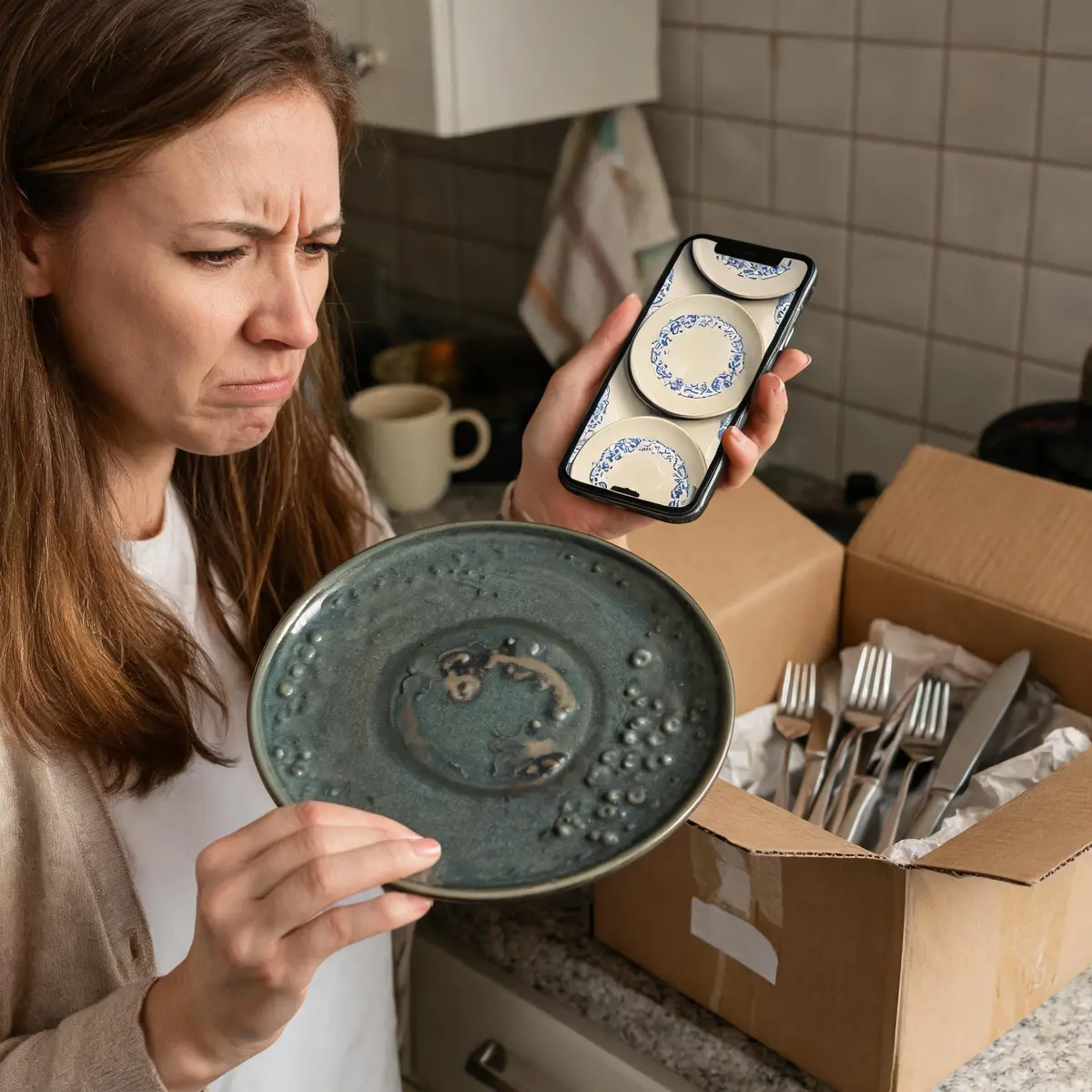
Ms. Lin, who just moved into a new home, fell victim to this problem: to match her cream-white kitchen, she spent over 200 yuan on a viral macaron-colored tableware set, and also purchased the same series of dish drying rack and storage rack. When she first arranged them in the cabinet, she posted photos on her WeChat Moments and received lots of likes. But all kinds of problems broke out in less than half a month: the plates were too slippery when holding sauced dishes, and food always fell onto the table when picked up; the soup bowls were only 3cm deep, and spilled when lifted even when only half full; the spoon handles had sharp edges, which made her knuckles red and sore after long-time holding; water from washed dishes could not drain out of the drying rack, leaking onto the countertop and soaking the newly installed waterproof strip; the storage rack buckle loosened and collapsed after only 8 plates were placed, breaking 2 soup bowls. In the end, only 3 pieces of the whole set were usable, and Ms. Lin regretted that she only focused on appearance at first and completely ignored design rationality.
Why Do Unreasonable Designs and Functional Defects Occur? In-depth Analysis of Root Causes
Tableware design defects are never “accidental manufacturing errors”. They are essentially the combined result of cost control, lack of standards, and demand mismatch, which we can analyze from three dimensions:
Material Science Dimension: Performance Compromise Caused by Cost Reduction
Many small and medium-sized manufacturers add excessive fillers to raw materials to cut costs and lower product prices: for example, excessive talcum powder added to wheat straw tableware leads to insufficient material rigidity, soft texture when pinched, and deformed edges that irritate hands when stressed; ceramic tableware is over-polished to save glaze, resulting in extremely low surface friction, so food slips off easily when picked up. Just like placing items on ice, they will slide off with the slightest movement, which is the inevitable result of compromised material performance, corresponding to the complaints like “very thin, soft, total garbage” in many negative reviews.
Manufacturing Process Dimension: Functional Failure Caused by Lack of Tolerance Control
Many small factories do not implement strict tolerance control during mold opening, leading to huge gaps between design drawings and mass-produced products: for example, a 1mm size error in the buckle of a spliced storage rack will make it impossible to fasten tightly, leading to easy falling off; if the drainage trough slope of a dish rack is miscalculated by 2 degrees during design, the finished product will be flat, and water cannot flow to the drain at all, just like a flat drainage ditch that will definitely accumulate water when it rains. The feedback like “spent unnecessary time assembling, flimsy and cheap, very disappointing” mentioned by many users is a typical manifestation of this type of problem.
Usage Habit Dimension: Adaptability Defects Caused by Demand Mismatch
Many manufacturers directly copy Western tableware as design prototypes. Western food uses flat plates for steak and salad, which do not require high plate edges, and soup bowls are mostly small portions under 200ml. But Chinese catering requires holding dishes with soup and drinking large bowls of soup over 400ml, so products directly copied from Western designs are completely unsuitable. It is like designing a plate only for bread for people who eat rice, which is awkward no matter how you use it. The feedback like “too small, totally not suitable for daily use” mentioned by many users is the embodiment of this type of problem.
Performance Comparison of “Unreasonable Design and Functional Defects” for Different Materials
Design defects of tableware made of different materials have completely different manifestations. We have sorted out the advantages, disadvantages and defect manifestations of common materials:
| Material Type | Common Design Defect Manifestations | Normal Performance of Qualified Products |
|---|---|---|
| Ceramic | Plate edge lifting angle < 10° leading to easy food slip; unrounded edges that irritate hands; body thickness < 2mm leading to easy breakage | Plate edge slope 15-25°, rounded and polished edges, body thickness ≥ 3mm, not easy to break under normal drop |
| Melamine (including wheat straw) | Excessive filler leading to insufficient rigidity and easy deformation; overly smooth surface that cannot hold food; odor released under high temperature | Sufficient hardness that cannot be pinched by bare hands, slightly matte frosted surface, meets food contact material standards |
| Metal tableware (stainless steel/titanium alloy) | Handle has no ergonomic curvature, sharp edges that irritate hands; single weight < 15g leading to unstable grip; single weight > 50g leading to fatigue after long holding | Handle has ergonomic grip curve, rounded edges, single weight 20-40g, steady grip feel |
| Plastic storage/dish rack | Drainage trough slope < 2° leading to water accumulation and leakage; large buckle tolerance leading to easy falling off; unstable splicing structure that falls apart easily | Drainage trough slope ≥ 3° allowing natural full drainage, embedded buckle with no looseness after fastening, overall structure does not shake when moved |
The feedback like “sturdy, different from the ones sold in physical stores”, “durable, good appearance” mentioned in many positive reviews is essentially the normal performance of products with qualified materials and qualified process control.
How to Avoid Unreasonable Design and Functional Defects? Purchase and Use Guide
Combined with the 4 most concerned issues of consumers, we have sorted out practical judgment standards, no professional knowledge is required, you can test it as soon as you get the product:
1. How to choose plates that do not let food slip off easily?
- Check plate edge lifting angle: Place a small cherry tomato on the plate edge and tilt the plate 15 degrees. If the tomato does not roll off, the slope is sufficient; do not use completely flat Western-style plates as Chinese dinner plates, the plate edge lifting height should be at least ≥ 1cm.
- Feel plate surface friction: Touch the plate surface with your fingers, do not choose highly polished glaze that is as smooth as a mirror. Slightly matte glaze has sufficient friction, so it is not easy to slip when holding sauced dishes.
2. How to choose a dish rack that does not leak water onto the countertop?
- Test drainage efficiency: Pour half a cup of clean water on the draining board. If all water flows into the water receiving tray within 10 seconds with no residual accumulation, the drainage path design is reasonable; prioritize models with extended water guide outlets on the water receiving tray, which can be directly aligned with the sink to avoid overflow when the water tray is full.
- Do not choose completely flat draining boards, even if they are advertised with hydrophobic coating, the coating will fall off after long-term use and still cause water accumulation.
3. How to choose a tableware storage rack that is easy to assemble and not easy to fall apart?
- Prioritize integrated structure storage racks, which have no risk of loose splicing at all; if you choose a spliced model, check that the buckle is embedded rather than insert-type, and there is no looseness when shaking by hand after the buckle is inserted, which means the tolerance control is qualified.
- Pinch the storage rack plate, do not buy thin plastic models that can be deformed by bare hand pinching, they are easy to collapse when loaded with heavy objects.
4. How to choose tableware that is comfortable to hold and does not irritate hands?
- Hold it for 30 seconds on site, if there are no sharp edges at the positions contacting the palm and knuckles, and the edges are rounded, it will not irritate hands.
- Weigh the weight: The weight of a single spoon/fork is most suitable between 20-40g, too light will feel flimsy and easy to slip, too heavy will cause fatigue after long holding.
Correction of Common Usage Misconceptions
- Do not buy completely flat plates as daily dinner plates just for appearance, they are only suitable for photo posing, not for holding Chinese food.
- Lighter tableware is not better, too light tableware is either too thin and easy to break, or has insufficient materials and poor rigidity.
- Clean the drain hole of the dish rack once a week, food residue blocking the drain hole will also lead to water accumulation and leakage.
“Pitfall Avoidance” Lessons from Real Users
We have selected the most representative user feedback from massive negative reviews to help you avoid pitfalls from other people’s bad experiences:
- User Feedback: “I ordered 3 sets of macaron-colored plates for a party, they look good, but small sauced snacks always slip off, they feel soft when held, and the edges hurt my hands” Lesson Summary: Do not make purchase decisions based solely on appearance and color matching. After receiving the tableware, first pinch the edges and test the anti-slip performance of the plate edge. If it deforms easily under stress and food slips off the plate edge easily, return or exchange it in time, do not make do with it.
- User Feedback: “The received tableware set is completely different from the promotional picture, the promotional picture shows soft mixed colors, but the actual color is overly bright, and the small plates are too small to hold dishes at all, the soup bowls are so shallow that they spill when only half filled” Lesson Summary: Be sure to check the size parameters of each piece of tableware before buying a set, do not only look at promotional renderings, pay special attention to whether the soup bowl depth, plate diameter, and plate edge lifting height meet your dining habits.
- User Feedback: “It took me almost an hour to assemble the storage rack I bought, it was wobbly after assembly, the buckle fell off and it collapsed after only 6 plates were placed, it feels as thin as paper, very poor texture” Lesson Summary: Prioritize embedded buckle for spliced storage products. Test assembly after receiving the goods, if the buckle is loose and the whole rack shakes obviously after splicing, return it directly, do not wait for it to collapse after loading heavy objects and cause additional loss of broken tableware.
- User Feedback: “I bought a whole set of tableware, the box was already broken when I received it, most of the plates were broken when I opened it. I got compensation after contacting customer service, but it took almost half a month to solve the problem” Lesson Summary: When receiving fragile tableware purchased online, check the outer packaging first, reject it directly if there is damage. Check the integrity of each piece immediately after unpacking, do not wait until you use it to find damage and miss the after-sales period.
- User Feedback: “Water always accumulates in the corners of the dish rack after use, cannot flow into the water receiving tray, I have to wipe it every time, otherwise it leaks onto the countertop and makes it damp” Lesson Summary: Test the drainage performance first when choosing a dish rack, pour a small amount of water on the draining board, if there is water accumulation and cannot flow into the water receiving tray completely, it means the drainage path design is defective, do not buy it.
Related Deep Analysis in This Category
- Goods Not As Described & Poor Quality Control — 22% of complaints relate to this
- Poor Quality and Easy to Damage — 42% of complaints relate to this
- Size & Specification Not As Advertised — 35% of complaints relate to this
🛠️ Practical How-To Guides
Based on the analysis above, we've prepared actionable daily solutions for you:
Dish Rack Collapsing Easily? 4 Details to Avoid Flawed Buckle Designs Before Buying
Addressing the pain points of collapsible assembled racks and easily detached buckles, teaching you to quickly judge stability and assembly logic through 4 structural details.
Read Full Guide →Kitchen Counter Always Wet? How to Choose a Dish Rack That Drains Perfectly and Prevents Mold!
Deep dive into dish rack drainage path designs, guiding you step-by-step to select and place racks properly, completely solving counter leaks and water pooling.
Read Full Guide →Sauce Spilling Everywhere? 3 Tricks to Pick the Perfect Chinese Deep Plate That Keeps Food in Place!
From edge curvature to inner wall friction, learn to avoid overly slippery designs and easily choose practical deep plates suited for Chinese dining.
Read Full Guide →